My daughter's school has a Maos Chitim campaign. This is a campaign that provides funds for matzah for those who otherwise would not be able to afford it.
My daughter is not allowed to go collecting door-to-door. However, she came up with an ingenious way of raising some money... she began selling a lot of the candy and nosh that she received for mishloach manos to schoolmates and contributing the money to the campaign.
It's great - it gets rid of all that candy, it raises money for the needy and it shows me that my daughter has an entrepreneurial spirit! I'm so proud of the little Wolfette!
The Wolf

Tuesday, March 28, 2006


Monday, March 27, 2006
On the Mutilation of Cabbage Patch Kids
Quick, Barbie, hide! Teddy Ruxpin better vamoose or he's headed for a mutilation! Take an eye off that Cabbage Patch doll! Raggedy Andy doesn't really *need* two arms does he?
The newest edict comes to us from Mordechai Eliyahu, a Sephardic rabbi in Israel. He has decreed that parents should amputate or mutilate their children's dolls so as to avoid an issue of idolatry. As Rabbi Eliyahu put it himself:
"It is very important that these toys do not remain intact so as to remove the element of idolatry."
Now, I'll be the first to admit that I'm not a Rav and will not pasken that the above sounds like a bunch of nonsense. I'll leave that to more learned individuals (Rabbi Student, are you out there?). However, my gut reaction tells me that there is a vast difference between an object venerated as a divine power and a child's plaything that isn't taken seriously by anyone except children and collectors.
But the question does have to be raised: Jewish children (along with non-Jewish ones) have been playing with dolls and stuffed animals for years. I've never heard a single story where Reb Moshe told his kids to "alter" their children's dolls. I've not heard one Chassidic Rebbe order the Chassidim in his sect to take an arm off of Barbie. Why not? If this is such an important issue (and we can agree that Avoda Zara *is* a big issue), why haven't we heard about this until now?
N.B. Of course, we're not talking about cases where dolls are (for whatever insane reason) actually worshipped as idols. My daughter happens to like her American girl dolls, but she doesn't *worship* them. I can only imagine my daughter's horror at telling her that I have to chop off one of Josephina's arms!
The Wolf
Hat tip: CustomerServant via Shmarya
The newest edict comes to us from Mordechai Eliyahu, a Sephardic rabbi in Israel. He has decreed that parents should amputate or mutilate their children's dolls so as to avoid an issue of idolatry. As Rabbi Eliyahu put it himself:
"It is very important that these toys do not remain intact so as to remove the element of idolatry."
Now, I'll be the first to admit that I'm not a Rav and will not pasken that the above sounds like a bunch of nonsense. I'll leave that to more learned individuals (Rabbi Student, are you out there?). However, my gut reaction tells me that there is a vast difference between an object venerated as a divine power and a child's plaything that isn't taken seriously by anyone except children and collectors.
But the question does have to be raised: Jewish children (along with non-Jewish ones) have been playing with dolls and stuffed animals for years. I've never heard a single story where Reb Moshe told his kids to "alter" their children's dolls. I've not heard one Chassidic Rebbe order the Chassidim in his sect to take an arm off of Barbie. Why not? If this is such an important issue (and we can agree that Avoda Zara *is* a big issue), why haven't we heard about this until now?
N.B. Of course, we're not talking about cases where dolls are (for whatever insane reason) actually worshipped as idols. My daughter happens to like her American girl dolls, but she doesn't *worship* them. I can only imagine my daughter's horror at telling her that I have to chop off one of Josephina's arms!
The Wolf
Hat tip: CustomerServant via Shmarya
Sunday, March 26, 2006
On The Economics of the Wilderness
My sons' yeshiva holds an annual Melave Malka for the boys in the upper grades. This year's event was held a few weeks ago. At the Melave Malka, the Menahel got up to speak. I don't really remember what the point of the speech was, but there was one part I do remember well.
He mentioned that his son asked him a question on Shemos (Exodus) 30:15:
The rich shall not give more and the poor shall not give less than the half-shekel...
His son asked him the following question... if all the Jews were rich when they left Egypt because of all the gold, silver, etc. that they took from Egypt upon the Exodus, then why does it say "the poor shall not give less?" Who was poor? Everyone was rich! Why does the Torah state "the poor shall not give less?"
The Menahel then said that it was a very good question and went on with his speech. I, on the other hand, thought it was a silly question. After all, was the Torah given *only* to the generation that left Egypt, or was it given to Jews of all time? Surely during the course of time, some would become richer and some would become poorer. The part of the verse that states "the poor shall not give less..." certainly applied to them.
However, even though I thought the question was a silly one, it started me thinking about the economics of the generation of the Wilderness; and in so thinking, I started realizing that certain assumptions that were inherent in the question were not necessarily so.
Firstly, the questioner states that all the Jews were rich. In fact, this may not really be so. After all, just because people have the opportunity to take gold and silver doesn't mean that everyone actually took the oppurtinity. No doubt some Jews were lazier than others, or maybe didn't have access to the same amounts of wealth to take as did other Jews. In addition, some may have lost some of their wealth in between the time that the Exodus occured and the time that the commandment to give the half-shekel was given? In short, there could be any number of reasons why some Jews were wealthy and some were not, or, at the least, not as wealthy as others.
Secondly, wealth is really a relative term. After all, what we call "the poor" in the United States today is really fairly wealthy when compared to other parts of the world. In a society made up exclusively of billionaires, the multi-millionaire lives in "poverty." So, naturally, even if *all* the Jews did take gold and silver from Egypt, there is no reason to say that they all did so equally. As I mentioned earlier, some may have simply been physically stronger (and able to carry more) while others may not have had access to as much gold as others. And those that had little gold were, in reality, "poor." This is all the more so in a closed society, as the generation of the Wilderness was; where there was limited contact with outside cultures and therefore limited opportunity to engage in commerce with people outside the group. Which leads to the topic of inflation.
Inflation, very simply, is when money loses it's value. The classic example of how inflation could occur is if the government would decide to simply start printing more money. The reason money is valuable is because it is scarce. If more of it suddenly appears, all of it starts to lose it's value. That's why the United States government cannot solve it's debt problem by simply printing up more money... becuase it would devalue the money supply that is currently out there.
The same principle, however, applies to any commodity. Gold is valuable for the same reason that money is... it's scarce. If someone were too (in a purely hypothetical example) find a gold mountain under the ice in Antarctica and bring all the gold here and sell it, it (and all the other gold in the world) would be nearly valueless, since the whole reason for it's value (it's scarcity) is gone.
Now apply this principle to the generation of the Wilderness. All of a sudden, everyone now has tons and tons (figuratively) of gold. Of what value is it? How are you to purchase anything with it? Let's give an example. Food and clothing, it seems could not be purchased in the Wilderness... why would you buy something that God is giving you for free? But perhaps pots and other vessels could be purchased. Imagine our ancient Israelite potter who toiled making pots for the Egyptians for years. Now a free man and loaded down with more gold than he can carry, he realizes that he may have a viable skill here in the wilderness. How much will his pots cost? Maybe in a "normal" society you might get three pots for a silver coin. But our potter has so much silver already! Is it worth his time to make three pots for a lousy silver piece? No, not really. Since he already has so much, you will need a lot more silver (and perhaps even gold) to make pot-making worthwhile for him. And so, inflation sets in. Whereas before a pot sold for a third of a piece of silver, now, because the money supply is so much greater, your piece of silver is almost as nothing. Now you have to use gold, and more of it, to purchase the pot. And so, the purchasing power (the true measure of the value of money -- after all, what good is money if you can't buy things with it) of the gold and silver has gone down. As a result, even if they all had a lot of gold or silver, so what? It hasn't really made everyone rich (unless compared to people outside the system - such as the other nations) - it merely redefined the value of the gold and silver. That's why the answer to poverty isn't to simply give everyone a million dollars - it doesn't really make anyone richer.
It seems that when Chazal stated that everyone who left Egypt was rich, they didn't really understand economics and how inflation works. Or, it could be, that they were speaking about the Jews being rich compared to the other nations. But within the Jewish nation, there certainly were still "poor" people, just as there are "poor" people within the United States today.
The Wolf
He mentioned that his son asked him a question on Shemos (Exodus) 30:15:
The rich shall not give more and the poor shall not give less than the half-shekel...
His son asked him the following question... if all the Jews were rich when they left Egypt because of all the gold, silver, etc. that they took from Egypt upon the Exodus, then why does it say "the poor shall not give less?" Who was poor? Everyone was rich! Why does the Torah state "the poor shall not give less?"
The Menahel then said that it was a very good question and went on with his speech. I, on the other hand, thought it was a silly question. After all, was the Torah given *only* to the generation that left Egypt, or was it given to Jews of all time? Surely during the course of time, some would become richer and some would become poorer. The part of the verse that states "the poor shall not give less..." certainly applied to them.
However, even though I thought the question was a silly one, it started me thinking about the economics of the generation of the Wilderness; and in so thinking, I started realizing that certain assumptions that were inherent in the question were not necessarily so.
Firstly, the questioner states that all the Jews were rich. In fact, this may not really be so. After all, just because people have the opportunity to take gold and silver doesn't mean that everyone actually took the oppurtinity. No doubt some Jews were lazier than others, or maybe didn't have access to the same amounts of wealth to take as did other Jews. In addition, some may have lost some of their wealth in between the time that the Exodus occured and the time that the commandment to give the half-shekel was given? In short, there could be any number of reasons why some Jews were wealthy and some were not, or, at the least, not as wealthy as others.
Secondly, wealth is really a relative term. After all, what we call "the poor" in the United States today is really fairly wealthy when compared to other parts of the world. In a society made up exclusively of billionaires, the multi-millionaire lives in "poverty." So, naturally, even if *all* the Jews did take gold and silver from Egypt, there is no reason to say that they all did so equally. As I mentioned earlier, some may have simply been physically stronger (and able to carry more) while others may not have had access to as much gold as others. And those that had little gold were, in reality, "poor." This is all the more so in a closed society, as the generation of the Wilderness was; where there was limited contact with outside cultures and therefore limited opportunity to engage in commerce with people outside the group. Which leads to the topic of inflation.
Inflation, very simply, is when money loses it's value. The classic example of how inflation could occur is if the government would decide to simply start printing more money. The reason money is valuable is because it is scarce. If more of it suddenly appears, all of it starts to lose it's value. That's why the United States government cannot solve it's debt problem by simply printing up more money... becuase it would devalue the money supply that is currently out there.
The same principle, however, applies to any commodity. Gold is valuable for the same reason that money is... it's scarce. If someone were too (in a purely hypothetical example) find a gold mountain under the ice in Antarctica and bring all the gold here and sell it, it (and all the other gold in the world) would be nearly valueless, since the whole reason for it's value (it's scarcity) is gone.
Now apply this principle to the generation of the Wilderness. All of a sudden, everyone now has tons and tons (figuratively) of gold. Of what value is it? How are you to purchase anything with it? Let's give an example. Food and clothing, it seems could not be purchased in the Wilderness... why would you buy something that God is giving you for free? But perhaps pots and other vessels could be purchased. Imagine our ancient Israelite potter who toiled making pots for the Egyptians for years. Now a free man and loaded down with more gold than he can carry, he realizes that he may have a viable skill here in the wilderness. How much will his pots cost? Maybe in a "normal" society you might get three pots for a silver coin. But our potter has so much silver already! Is it worth his time to make three pots for a lousy silver piece? No, not really. Since he already has so much, you will need a lot more silver (and perhaps even gold) to make pot-making worthwhile for him. And so, inflation sets in. Whereas before a pot sold for a third of a piece of silver, now, because the money supply is so much greater, your piece of silver is almost as nothing. Now you have to use gold, and more of it, to purchase the pot. And so, the purchasing power (the true measure of the value of money -- after all, what good is money if you can't buy things with it) of the gold and silver has gone down. As a result, even if they all had a lot of gold or silver, so what? It hasn't really made everyone rich (unless compared to people outside the system - such as the other nations) - it merely redefined the value of the gold and silver. That's why the answer to poverty isn't to simply give everyone a million dollars - it doesn't really make anyone richer.
It seems that when Chazal stated that everyone who left Egypt was rich, they didn't really understand economics and how inflation works. Or, it could be, that they were speaking about the Jews being rich compared to the other nations. But within the Jewish nation, there certainly were still "poor" people, just as there are "poor" people within the United States today.
The Wolf
Tuesday, March 21, 2006
On Music
I posted once, a while back, about how music tends to "bleed" through different cultures. Music, of course, is fairly universal and tends to get copied from one culture to the next. That's why I've heard zemiros sung to Simon and Garfunkel tunes, among other things.
Steg, in his comment to my point made the following comment:
One of the main points of my presentation was the oral nature of the musical culture; tunes enter into it, and once a few years go by, or the tune becomes popular and passed from person to person, no one has any idea who invented it or where the tune came from — it's all ya‘ni "halakha leMoshe miSinai". That's why you have, as you mentioned, people who would never listen to Simon and Garfunkel or the Beach Boys use their tunes for zemiros.
Of course, there was one aspect that I didn't count on when I thought of that post months ago - the aspect of outright copying. There are times that popular Jewish musicians will outright copy tunes from other, secular sources.
Considering that many chareidi people won't listen to any secular music since the music itself (even sans lyrics) can be metamem es ha-lev, I'm curious how many of them realize that a song that they've all heard many times at weddings is actually ripped off from a German pop-band of the 1980s. The song, specifically is Yidden, which seems to be de riguer at weddings these days. The tune originally came from a German pop band called Dschingis Khan, from their eponymous song. You can view the video for it here.
Will there be a call to ban the sale of Yidden tapes and CDs (and the playing of it at weddings)? Somehow, I don't think so...
The Wolf
Steg, in his comment to my point made the following comment:
One of the main points of my presentation was the oral nature of the musical culture; tunes enter into it, and once a few years go by, or the tune becomes popular and passed from person to person, no one has any idea who invented it or where the tune came from — it's all ya‘ni "halakha leMoshe miSinai". That's why you have, as you mentioned, people who would never listen to Simon and Garfunkel or the Beach Boys use their tunes for zemiros.
Of course, there was one aspect that I didn't count on when I thought of that post months ago - the aspect of outright copying. There are times that popular Jewish musicians will outright copy tunes from other, secular sources.
Considering that many chareidi people won't listen to any secular music since the music itself (even sans lyrics) can be metamem es ha-lev, I'm curious how many of them realize that a song that they've all heard many times at weddings is actually ripped off from a German pop-band of the 1980s. The song, specifically is Yidden, which seems to be de riguer at weddings these days. The tune originally came from a German pop band called Dschingis Khan, from their eponymous song. You can view the video for it here.
Will there be a call to ban the sale of Yidden tapes and CDs (and the playing of it at weddings)? Somehow, I don't think so...
The Wolf
Wednesday, March 01, 2006
In defense of the Frumteens Moderator
You must all be wondering... did the Wolf go insane? Has he been howling at the moon too long? Has he become a Chareidi, Young-Earth Creationist who believes that lice grow from the ground and that the sun orbits the earth?
No, not quite.
I've posted once before on something that the Frumteens Moderator said regarding the conflict of science and statements of Chazal. However, after reading another post of his, I've decided to revisit the issue.
In short, I'm beginning to think that the FrumTeens Moderator agrees with us that Chazal weren't perfect in their knowledge of science. He just doesn't know the meaning of the word "science." Once he actually understands what it is, he might even agree with us.
For example, consider the following:
When a poster asked him about the famous Chazal statement of lice being spontaneously generated, he stated:
When Chazal discuss life, or what constitutes animal mineral or vegetable, they are using the Torah’s definitions, not the scientists’.
Now, this statement is actually fairly rational when you look at it in the proper light. For example, take the old objection by Biblical Critics that the Torah mentions the bat among the list of birds that are non-kosher. The bat, as we all know, is not a bird, but a mammal. Of course, this objection can be overturned by pointing out that the word of, which the Torah uses when mentioning these animals, does not mean what we, today, call a bird, but actually includes any and all flying creatures (except for insects which were called sheretz ha-of). By doing this, we can show that the Torah does not mistakenly call a bat a "bird."
It would seem that the FTM is actually doing the same thing here. He goes on to state:
And the Torah’s definitions of all of the above depend not on physical characteristics but spiritual ones. An inanimate object has a Nefesh Hadomem – the “spirit” (which is a better translation than “soul”) of an inanimate object; plant life has a Nefesh HaTzomeches; animal life, a Nefesh HaBehamis, and a human being, a Neshomah.
It would seem from this that the FTM would agree that, from a biological standpoint, lice do indeed come from eggs and are not spontaneously generated. That Chazal said that they were spontaneously generated is simply because they are not talking about the biological nature of the animal. (Of course, I'm being overly kind here and making the assumption that Chazal *really* knew that lice come from eggs in the biological sense.)
He reiterated this again with another post (later down in the same thread) where he brings down the Maharal (Ber Hagolah 6). He quotes the Maharal (I'm taking his word for it - I haven't looked at the original) as stating:
Some people say that Chazal were not experts in the sciences. They say this because they see things stated by Chazal regarding causes of natural phenomenon that seeem unlikely to be true. But the truth is not as these people claim, because when Chazal spoke about natural causes they did not mean superficial, physically scientific causes - that is fitting for scientists or doctors, not for our sages. Our sages, on the other hand, when they spoke about the causes of nature, were referring not to causes that are natural but to what causes nature to act the way it does.
Of course, the whole irony of the situation here is that the FTM does not know what "science" is! He's clearly taken a position that if you conduct an experiment, and find that the results of the experiment contradict statements of Chazal, it just means that the Chazal were misunderstood and were speaking spiritualy. They weren't speaking in a scientific sense; they were speaking in a spiritual sense. However, of course, that negates the very claim that Chazal knew all of science (unless, one subscribes to the dubious position that they knew lice come from eggs, but purposely made a statement that differs from their knowledge in order to make a spiritual point)! Otherwise, he wouldn't be claiming that Chazal weren't speaking from a biological standpoint - he'd be calling the scientists who maintain the existence of lice eggs liars.
So, I hereby invite the FTM to join with us. There's room under our tent for him as well. Consider the following examples:
- The universe is only a few thousand years old? Well, when Chazal said that, they meant it in a spiritual sense. On a physical level, however, it is billions of years old.
- The earth orbits the sun? Well, Chazal meant it in terms of importance, since the earth is where we are and where the Torah is kept and learned. Therefore, on a spiritual level, it's the center of the universe. However, on a purely physical level, the earth orbits the sun.
- Half earthen-half animal mice? Well, Chazal may have meant that on a spiritual level, this is to symbolize God's creation of man (or rebirth at T'chiyas HaMesim). However, on a purely physical level, such creatures don't exist.
And it goes on and on. So, how about it FTM? Care to join us rationalists? All you have to do is understand that what you are stating as "science" is exactly the opposite of it and admit that statements of Chazal are true on a *spiritual* level and not on a physical level. It's not that hard... you're already doing it on your site.
And then you can recommend Rabbi Slifkin's books. :)
The Wolf
Tuesday, February 28, 2006
On Hypothetical Shidduch Calls
Riiiiiing! Riiiiiiiing!
"Hello? Hello? Hi! How can I help you?"
"You need a shidduch for your son? Well, you've come to the right place, um... what was your name?"
"Yossi. Right. Well, you've come to the right place. I'm sure we can find your son's bashert. Now, of course, I'll need a little information about him. For starters, how old is he?"
"Forty? Did you say forty?! Well, truth be told, that's kind of old for a shidduch. Has he ever been married? No, well, OK, let's see what we can do. Next question: what does he do for a living?"
"Excuse me, did you say livestock? Ooooooookay. I just wanted to make sure that I heard that correctly. How about his education. What yeshiva did he go to?"
"None! He hasn't gone to yeshiva at all? He knows nothing? How is it that a child in a Jewish home didn't go to yeshiva. Didn't his grandparents offer to chip in for tuition if you couldn't afford it?"
"Oh, I see. Your parents aren't Jewish. You're a ger. So, any girl he marries will have a ger for a father-in-law and non-Jewish grandparents-in-law. To speak frankly, Yossi, the prospects for your son are rather dim. I don't know of any girl that would marry him. Well, let's try one more approach. Do you have any money?"
"No. Poor. Hmm. Well, I'm sorry Yossi. I don't think I'm going to be able to find a girl for your son. I just don't think it's possible. To be honest, between your son's lack of yichus, learning and money, there's simply no hope for... what was his name again?"
"Akiva. Right. I'm sorry, but there's just no hope of getting a shidduch for him."
The Wolf
"Hello? Hello? Hi! How can I help you?"
"You need a shidduch for your son? Well, you've come to the right place, um... what was your name?"
"Yossi. Right. Well, you've come to the right place. I'm sure we can find your son's bashert. Now, of course, I'll need a little information about him. For starters, how old is he?"
"Forty? Did you say forty?! Well, truth be told, that's kind of old for a shidduch. Has he ever been married? No, well, OK, let's see what we can do. Next question: what does he do for a living?"
"Excuse me, did you say livestock? Ooooooookay. I just wanted to make sure that I heard that correctly. How about his education. What yeshiva did he go to?"
"None! He hasn't gone to yeshiva at all? He knows nothing? How is it that a child in a Jewish home didn't go to yeshiva. Didn't his grandparents offer to chip in for tuition if you couldn't afford it?"
"Oh, I see. Your parents aren't Jewish. You're a ger. So, any girl he marries will have a ger for a father-in-law and non-Jewish grandparents-in-law. To speak frankly, Yossi, the prospects for your son are rather dim. I don't know of any girl that would marry him. Well, let's try one more approach. Do you have any money?"
"No. Poor. Hmm. Well, I'm sorry Yossi. I don't think I'm going to be able to find a girl for your son. I just don't think it's possible. To be honest, between your son's lack of yichus, learning and money, there's simply no hope for... what was his name again?"
"Akiva. Right. I'm sorry, but there's just no hope of getting a shidduch for him."
The Wolf
Monday, February 27, 2006
It Was The Best Of Weddings, It Was The Worst Of Weddings
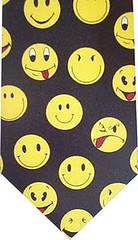
I recently attended a wedding of a daughter of someone who lives and works in our neighborhood. Over the last year or so, we've seen them quite often (they run a business that we frequent in the neighborhood) and have become friendly with them. Even so, we certainly didn't expect an invitation to their daughter's wedding, and was pleasantly surprised when it appeared in our mailbox.
The wedding itself was a lovely affair. The music was good, the food was fine, and the dancing was energetic and spirited. In the spirit of having fun, I had begun wearing offbeat ties to weddings. The one in the picture was the one I wore last night.
So, how was it the worst of weddings?
Well, did you ever go to a wedding where you know *no one* except for the groom or bride? Well, that was the situation last night. Aside from my wife (whom I couldn't sit with because of separate seating), I knew no one at the wedding last night. But, I figured, that's OK. Maybe I'll sit with someone interesting. Sometimes my tie itself acts as an icebreaker.
So, I arrive at my table after the chuppah, the first one there. I grab a seat, sit down and wait.
Within a few minutes, an older gentleman comes to the table and sits down about two seats away from me. He's a chossid, complete with beard, hat, black garb, white shirt, no tie and long peyos. He starts greeting me (or at least I suppose so) in Yiddish. I tell him that I don't speak Yiddish. "Ivrit? (Hebrew)" he asks. "Ketzat (a little)," is my reply. He begins speaking in rapid-fire Hebrew, but it's clear within three sentences that he's lost me.
Soon a few more people show up at the table - some older, some younger - all chassidim - with beards, black hats, black garb, white shirt, no tie and long peyos. Eventually the table was filled (except for the seats on either side of me) with chassidim animatedly chattering in Yiddish - and me - with no hat, blue suit, clean shaven, funny tie and peyos neatly trimmed and barely able to speak a word of the language. The whole thing was so sad (from my perspective) that it was funny. I called my wife and told her "Come over and take a look at my table. You're not going to believe this." When she spotted my table, she started laughing at how comical and sad the situation was.
So, there I sat, passing on the fish, eating the soup and watching the others at my table. Aside from the gentleman who tried to address me and one (who arrived later in the meal and said "hello" in English, no one acknowledged my presence). Truth be told, however, I'm not all that much of a socializer, so it wasn't *that* bad.
That is, until I got a look at the table manners that some of them had. Oy vey!
There were some there that had impeccable table manners. But there were some...
- Two of them ate their salads with their hands.
- During the main course, one of them started picking apart his green beans with his hands. If he had been trying to remove the peas, I might have excused it. But then he ate the whole thing anyway!
- One person put a knife in his mouth to clean it off (N.B. I'll sometimes do this too - but only in private. I'd never do it in public!)
- Another fellow picked up a wine bottle and, upon finding that the bottle was empty, started biting on and sucking on the cork!
- One "gentleman" apparently didn't know how to use a knife since he picked up his chicken cutlet whole and just bit chunks off of it.
- Two fellows at the table took an extra main portion and split it between themselves (and this was before they even started the "first" portion that they had).
- One fellow asked another to pass him the Diet Coke. The second fellow then picked up the Diet Coke, poured most of it into his own glass and then passed the rest (maybe half a cup's worth) to the first guy.
Now, it's certainly possible that I'm obsessed and compulsive about table manners. My kids know not to do these things - most of these things are things that we've pounded into our kids at the dinner table since day one (well, except for the wine bottle...). And if it was just one lapse or two, I could also overlook it. But it was a group of people displaying the most atrocious table manners that I have seen adults display in a long, long time. I certainly don't expect perfection from anyone, but the display I saw at the wedding was just too much for me.
So, as for the ceremony, smorgasbord, hosts, dancing and even the food, it was the best of weddings.
As for the people at my table, it was the worst.
Friday, February 24, 2006
Off Topic: Book Recommendation - 102 Minutes
I know that this has nothing to do with Judaism or the frum community, but please bear with me.
I just finished reading 102 Minutes, by Jim Dwyer and Kevin Flynn. The book covers what happened in the World Trade Center complex in the 102 minutes between when the first plane struck and when the last tower fell.
Based on interviews with survivors, friends and relatives, and transcripts of police/fire/911 recordings, Dwyer and Flynn reconstruct the stories of several dozen people who were in the towers that day, some of whom made it out and some of whom didn't. The book describes the rescue efforts, the problems that were faced by rescuers and workers based on building design, FDNY/NYPD/PAPD policies and the physical conditions created by the airplanes.
The book shows how many people were affected that day by the choices that they made - and how in many cases, those choices meant the difference between surviving and not making it.
Throughout the book, you get to know the people who were in the buildings, the firefighters and police officers who went in to the buildings to rescue people trapped, and the civilians who (some at the cost of their own lives) went through the building helping escape from trapped rooms, elevators and infernos.
I was about a block and a half away when the towers came down on Sep 11, 2001. I had been working in the neighborhood for almost ten years to that point, and had seen the towers on a daily basis and been in them many times. So, the even though I knew no one personally who died that day, I still feel a personal connection with the events of that day.
I found myself unable to put the book down, captivated by the accounts of people struggling to survive in such horrific conditions and others going into the buildings to rescue them.
As a side note, the book does recount the stories of two Orthodox Jews who were in the towers that day - Abe Zelmanowitz, who remained behind in the towers with a paraplegic friend, and Shimmy Biegeleisen, who was trapped above the crash zone.
The Wolf
I just finished reading 102 Minutes, by Jim Dwyer and Kevin Flynn. The book covers what happened in the World Trade Center complex in the 102 minutes between when the first plane struck and when the last tower fell.
Based on interviews with survivors, friends and relatives, and transcripts of police/fire/911 recordings, Dwyer and Flynn reconstruct the stories of several dozen people who were in the towers that day, some of whom made it out and some of whom didn't. The book describes the rescue efforts, the problems that were faced by rescuers and workers based on building design, FDNY/NYPD/PAPD policies and the physical conditions created by the airplanes.
The book shows how many people were affected that day by the choices that they made - and how in many cases, those choices meant the difference between surviving and not making it.
Throughout the book, you get to know the people who were in the buildings, the firefighters and police officers who went in to the buildings to rescue people trapped, and the civilians who (some at the cost of their own lives) went through the building helping escape from trapped rooms, elevators and infernos.
I was about a block and a half away when the towers came down on Sep 11, 2001. I had been working in the neighborhood for almost ten years to that point, and had seen the towers on a daily basis and been in them many times. So, the even though I knew no one personally who died that day, I still feel a personal connection with the events of that day.
I found myself unable to put the book down, captivated by the accounts of people struggling to survive in such horrific conditions and others going into the buildings to rescue them.
As a side note, the book does recount the stories of two Orthodox Jews who were in the towers that day - Abe Zelmanowitz, who remained behind in the towers with a paraplegic friend, and Shimmy Biegeleisen, who was trapped above the crash zone.
The Wolf
Wednesday, February 22, 2006
Is Tisha B'Av Your Favorite Holiday?
Apparently, it is the favorite of many people.
The OU currently has a poll up on their site, asking people what their favorite holiday is. The choices are Passover, Shavout, Tisha B'Av, Rosh HaShannah, Yom Kippur, Sukkot, Channukah or Purim.
The results so far (out of 4543 votes cast):
Rosh HaShannah 4%
Yom Kippur 5%
Channukah 6%
Shavout 7%
Sukkot 10%
Passover 18%
Purim 23%
and leading with 27% and over 1200 votes... Tisha B'Av!
I can only attribute this to open tampering, as I highly doubt that 25% of Jews (even in a SLOP) would actaully list Tisha B'Av as their favorite holiday.
I'm kind of curious, however, about what the OU was thinking when they put that choice up there. I would sooner have put Tu B'Shvat than Tisha B'Av.
The Wolf
The OU currently has a poll up on their site, asking people what their favorite holiday is. The choices are Passover, Shavout, Tisha B'Av, Rosh HaShannah, Yom Kippur, Sukkot, Channukah or Purim.
The results so far (out of 4543 votes cast):
Rosh HaShannah 4%
Yom Kippur 5%
Channukah 6%
Shavout 7%
Sukkot 10%
Passover 18%
Purim 23%
and leading with 27% and over 1200 votes... Tisha B'Av!
I can only attribute this to open tampering, as I highly doubt that 25% of Jews (even in a SLOP) would actaully list Tisha B'Av as their favorite holiday.
I'm kind of curious, however, about what the OU was thinking when they put that choice up there. I would sooner have put Tu B'Shvat than Tisha B'Av.
The Wolf
On the Push For Tuition Tax Credits
Or at least accoring to Rabbi Eli Monsour.
I was mass-forwarded an email this morning a letter from Rabbi Monsour, discussing why we should support the tuition tax credits for parents who send their kids to yeshivos.
If my understanding of this is correct, the general idea is that we should support a bill in the legislature that will provide a $500 tax credit to private school parents to help defray the rising costs of tuition. Certainly, that's how the bill is being presented to the members of the New York State Senate and Assembly - as a measure to help parents pay the costs of tuition.
However, I'm struck by the following paragraph in Rabbi Monsour's letter (bolding mine)
Needless to say, private school tuition costs are one of, if not the largest monetary burden facing our families. If this bill, which is coming before the New York State Legislature next month, were to pass, - the strain on many of our community?s organizations, including; the Sephardic Bikur Holim, the Sephardic Angel Fund, the Sephardic Food Fund, and even Sephardic SAFE, will be greatly reduced. Even our Yeshiva?s will be less pressured, as the need to provide student scholarships and discounted tuition costs will be sharply reduced.
In his first statement, Rabbi Monsour is certainly correct. Private school tuitions *are* one of the largest costs facing families that send their children to yeshivos, parochial or other private schools. However, by the time he gets to the last sentence, he seems to have forgotten the first. My understanding of his last sentence (and if you have a different interpretation, I'd like to hear it) is that yeshivos will be able to reduce scholarships that they provide to parents who can't afford it, because the parents will have extra money to pay. In other words, the bill that is supposed to provide monetary relief to families, in fact, will provide none. If the scholarships for families that have them will be reduced by the amount of the tax credit, then the net change in cost to the parent will be zero. That is not a relief for parents.
I find this all just a bit dishonest. If one wants to frame the bill as a measure to increase funding to schools, then by all means, frame it that way. But I find that framing it as a relief for parents when (as my reading of Rabbi Monsour's statements) in fact, the parents will see no real monetary benefit from it, is just dishonest.
I'm not necessarily opposed to the idea of additional funding for schools and students. But I believe that if that is the goal, it should be presented in that manner, and not as a bogus measure to provide relief to parents.
(cross-posted with entire text of email over at Hashkafah.com)
The Wolf
I was mass-forwarded an email this morning a letter from Rabbi Monsour, discussing why we should support the tuition tax credits for parents who send their kids to yeshivos.
If my understanding of this is correct, the general idea is that we should support a bill in the legislature that will provide a $500 tax credit to private school parents to help defray the rising costs of tuition. Certainly, that's how the bill is being presented to the members of the New York State Senate and Assembly - as a measure to help parents pay the costs of tuition.
However, I'm struck by the following paragraph in Rabbi Monsour's letter (bolding mine)
Needless to say, private school tuition costs are one of, if not the largest monetary burden facing our families. If this bill, which is coming before the New York State Legislature next month, were to pass, - the strain on many of our community?s organizations, including; the Sephardic Bikur Holim, the Sephardic Angel Fund, the Sephardic Food Fund, and even Sephardic SAFE, will be greatly reduced. Even our Yeshiva?s will be less pressured, as the need to provide student scholarships and discounted tuition costs will be sharply reduced.
In his first statement, Rabbi Monsour is certainly correct. Private school tuitions *are* one of the largest costs facing families that send their children to yeshivos, parochial or other private schools. However, by the time he gets to the last sentence, he seems to have forgotten the first. My understanding of his last sentence (and if you have a different interpretation, I'd like to hear it) is that yeshivos will be able to reduce scholarships that they provide to parents who can't afford it, because the parents will have extra money to pay. In other words, the bill that is supposed to provide monetary relief to families, in fact, will provide none. If the scholarships for families that have them will be reduced by the amount of the tax credit, then the net change in cost to the parent will be zero. That is not a relief for parents.
I find this all just a bit dishonest. If one wants to frame the bill as a measure to increase funding to schools, then by all means, frame it that way. But I find that framing it as a relief for parents when (as my reading of Rabbi Monsour's statements) in fact, the parents will see no real monetary benefit from it, is just dishonest.
I'm not necessarily opposed to the idea of additional funding for schools and students. But I believe that if that is the goal, it should be presented in that manner, and not as a bogus measure to provide relief to parents.
(cross-posted with entire text of email over at Hashkafah.com)
The Wolf
Subscribe to:
Posts (Atom)