Showing posts with label rabbinic authority. Show all posts

Tuesday, August 24, 2010

Rabbinic Approval of Community Events


The Jewish Community Council of Marine Park is sponsoring an emergency blood drive tonight at K'hal Bnei Torah ("Rabbi Schiffenbauer's shul" -- 3514 Flatlands Avenue -- Google map link) from 6:30 to 11:00 PM tonight.  I urge all those who are eligible to give blood to do so.  I plan to be there myself later on in the evening and drop off a pint of Wolfish blood.  Donating blood is a mitzvah and saves lives.  On top of that, they'll even serve you dinner too.

I found out about this event through a flier that was distributed in various shuls in the neighborhood.  At the bottom of the flyer were printed the following words:

This Blood Drive has the complete support & endorsement of the Vaad Horabbonim of Marine Park.

This is not the first time I've seen this sort of disclaimer for an event.  In fact, I've been seeing them more and more often over the last few years on all sorts of events from children's carnivals to gatherings to discuss serious communal issues.

I'm not going so far as to say that there are no events that shouldn't have rabbinical oversight or endorsement, but one wonders why you would need rabbinical endorsement for something as simple as a blood drive.  Even if you thought there might be a halachic issue with giving blood (I'm certainly not aware of any issues that  have a valid logical basis), that's why we have rabbis to ask questions of, correct?  If I saw a flier for a blood drive and I thought it might be a problem, I would simply call up my local orthodox rabbi and say "Rabbi, there's a blood drive tonight and I'd like to donate but I'm not sure if it's allowed because of reasons X, Y and Z..."  You should not require a rabbinic committee to approve an event or organization that is a mitzvah and providing a benefit to the community.  An ad to raise funds for a charity such as Tomche Shabbos shouldn't need to say something along the lines of "approved by the Vaad Harabbonim of...." That's not to say that organizations shouldn't have a rabbinic adviser to whom they can turn when they have a question -- organizations should have just such an adviser.  But this obsession with getting rabbinic approbation for any event is just another sign of the fact that common people are abdicating their responsibility to use common sense and good judgment.

One wonders where this is all going in the future.  Will my kids be sending out invitations to their sons' bar mitzvahs with the line "Approved by the Vaad harabbonim..." on it?  Or will my future five-year old grandchildren receive an invitation to a friend's birthday party that reads "Come to Chavie's Birthday Party!  Approved by the Vaad Harabonnim!?"

The Wolf

Monday, March 19, 2007

Conditional Divorces?

I came across this rather disparagingly-titled article in Ha'aretz. It discusses the case of a woman in Israel who received her get several years earlier, with a condition attached that stated that any issues that had been discussed at the outset in the beis din (rabbinical court) have to be continued there. Recently, a dispute broke out over the education of their children (which was not discussed in the beis din, according to a representative for the woman) and the woman went to the (secular) Family Court to have the problem adjudicated. The man claimed that this was a violation of the agreement and went to a Tel Aviv beis din who ruled that by going to the secular courts, she may have violated the condition and invalidated her get.

The big problem here is that the woman has since remarried and had a child. If the get in invalidated, then she would have to divorce her (second) husband and her child could be declared a mamzer. She appealed to the Supreme Rabbinical Court, but the case has been delayed for a year already.

As the article states:

The delay also puts the woman in an impossible situation: If it is eventually decided that the get is invalid, she is already forbidden to have conjugal relations with her present husband.

The rest of the article goes on to describe (unflatteringly) some of the edicts that R. Eliyashiv has decreed in the past few years. I don't really wish to discuss that... my feelings about both the edicts and the disparaging of a talmid chochom (even if you disagree with him) are well known. What I do want to discuss is the very idea of a conditional divorce itself.

Now, I'll be the first to admit that I am no expert in Hilchos Gittin. You certainly won't find me sitting on a beis din that terminates marriages - I am certainly not learned enough, nor am I particularly anxious to take on the responsibility. However, one thing which I am pretty sure that I remember learning is that a conditional divorce can only be valid if the condition is limited. The classic case is someone issuing a divorce on condition that the woman never drink wine or never visits her father's house is null and void, because it is not a document of separation -- she is still bound to him forever by the condition. However, a temporary condition is valid (i.e. she not drink wine for thirty days), since at the end of the condition period, she is fully separated from him.

Now, I don't know if the condition in the get mentioned at the start of this post was only temporary -- I'd have to assume that it was (and that the members of the beis din know halacha better than I do). But, to be honest, I find the whole idea of allowing conditional gittin to begin with to be bad public policy. The situation that the woman now finds herself in is surely an untenable situation -- she doesn't have her first marriage, she doesn't really have her second marriage either and is simply stuck until the Supreme Court hears her case (why does it take a year, anyway?!). It's bad enough when there are situations when a husband will not give a get to begin with, but it's even worse when he gives a conditional get and can trap her ex post facto on a real or imagined violation of a condition.

I certainly don't have a problem with a husband having a say in where his children are educated. If there is a dispute as to where the child should go to school, it certainly should be adjudicated in the agreed upon manner -- and there should be penalties that can be applied to those who break the agreements, but invalidating a get should not be one of them. The potential for damage to not only the woman but to her new husband and any children born of the marriage is just simply too great.

In short, let's leave a get to what it should be - a davar hakores (a thing that separates) - and not something that leaves the woman still bound to her first husband and the potential for multiple ruined lives down the road.

The Wolf

Thursday, January 04, 2007

A Note On The Clothing Store Activists in B'nei Brak

(Wow! Two posts in one day!)

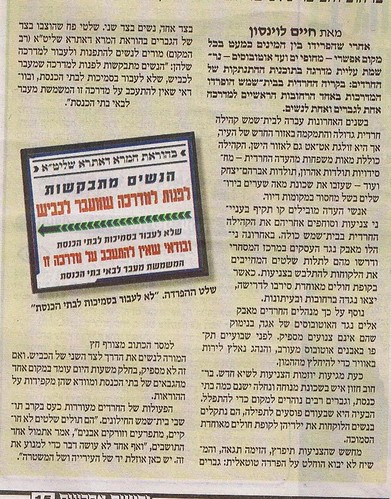
I was reading an article in this week's Yated about the activists who have started insisting that stores in B'nei Brak must sell only clothing that appeals to certain standards or not be placed on a "white list" of stores where chareidim there may not shop.

The activists (known as the Vaadas Hapikuach Lechanuyos) brought a list of stores who have complied to Rav Aharon Leib Shteinman. According to the article (bolding mine):

HaRav Aharon Leib Shteinman read through the list with obvious satisfaction and wondered aloud how there could be chareidi store owners who have not yet joined the program. HaRav Wosner said he was pleased be'ezras Hashem there are now clothing stores where Jewish women can shop without concern, and expressed confidence additional store owners would join the program. HaRav Nissim Karelitz, who has guided the organization since its founding, encouraged the delegates and suggested a course for further activity.

I find it interesting that the path of action to take was to pressure the stores, rather than to pressure the individual buyers. If one were to successfully pressure the individual buyers, then the buyers would not buy the items and the stores would not sell them. The most obvious example would be a store that sells ham (among other items) in an exclusively Jewish neighborhood. Since no one is going to buy the ham, eventually the store owner would see the futility of carrying it and stop doing so.

It would seem to me that the need to pressure the stores stems from a failure of the activists to pressure the people individually. Since they can't (or won't) tell their women not to buy certain articles of clothing (or the women won't listen to such instructions), they feel that they must remove the opportunity to buy them.

Of course, however, that, too, is a failing proposition. While it may make it more difficult for women to shop for clothing that they want, it certainly won't prevent them from doing so entirely. One can always drive or hop on a bus and go to the next town to find clothing, purchase it through mail-order or the internet, or some other way.

In short, if you want any sort of ban to succeed, you have to first win over the will of the people. If you can convince the people that the ban is necessary, then you won't have to resort to pressuring shopkeepers - economics will take care of the problem for you. If you can't convince the people of the necessity for the ban, then, in today's global market, pressuring the shopkeepers will harm no one but the shopkeepers.

The Wolf

Tuesday, November 21, 2006

Separate Sidewalks?


Much has been written about the recent Tznius asifa in Israel. I plan to comment on it too in the future, but I need to get some materials together. In short, I think that raising people's conciousness about tznius is a good thing (even if the asifa went about it in a completely wrong fashion - but that's for another post).


However, there are times when it gets carried too far - and I think that the residents of Beit Shemesh (where I have relatives living) have reached that point. In parts of the town, there are now separate sidewalks for men and for women. Signs are posted on the street advising women that they have to cross over to the other side of the street. Women are not allowed on the side of the street where the shul is located.


Now, lest I sound like someone who is in favor of licentiousness and free love, let me reiterate that standards of tznius are a good thing. Lord knows I don't need to see any more bare midriffs in New York in the summer. But the idea that the sexes have to be so completely separated that they can't even walk on the same street is ludicrous.

Has there ever been a Jewish community where it was noted that this standard was observed? Did our ancestors in the midbar walk on different sides of the paths between tents? When Dovid danced in the streets, did he do it on the men's side? In any of the shtetls in Europe, was there ever a reqirement that the men and women occupy different streets?

Rabbi Maryles has noted in his blog recently the ever-increasing trend toward the separation of the sexes, starting with separate seating by weddings, to the ever-increasing fact that the kallah does not come over to the men's side during the dancing, to separate seating by Sheva Berachos - even of the chosson and kallah!

I recently read a science fiction series by Robert J. Sawyer called the Parallax Trilogy. The series centers on a world where the Neanderthals, not humans, survived and became the dominant species of the planet. On the Neanderthal world, the sexes live separate lives for most of the month. For 25 out of every thirty days, the men live in one community and the women (and small children) live in another. It is only during the remaining five days (when "Two Become One" that the men and womenfolk get together.

One has to wonder if that isn't the goal for some of the ultra-zealots - to, in short, have separate communities where men will sit and learn all day and not be distracted by the womenfolk and the women will work and support the men without being distracted by their presence. Of course, I realize that I'm greatly exaggerating the situation - after all, we're only talking about separate sidewalks, not separate houses and communities. But sometimes, I feel like that is the direction that we are headed in.

What ever happened to taking a moderate approach?

The Wolf

Wednesday, November 15, 2006

Bloggers and Torah Authority

DovBear reflects on the upcoming Agudah convention and the anticipated address regarding bloggers. Based on the advertising (as reported by Orthomom), it seems that the speech is being framed as a bloggers vs. Torah Authority showdown.

As DB points out in his post, there are many, many more pressing issues that could be dealt with at the convention than bloggers. I don't think I need to repeat what those issues are (and I think he left off a few good issues as well); we all know what the strengths and weaknesses of our Orthodox communites are. What I would like to focus on is the issue of blogging and the question that is asked by the advertisement "Have bloggers declared open season on Torah Authority? "

Of course, to state that the "bloggers" have any opinion is like saying that "New Yorkers" are in favor of a particular opinion... the bloggers are a diverse crowd with diverse opinions. Are there some bloggers that have "declared open season" on Torah authority? Probably. The fact of the matter is that the J-Blogosphere is a very diverse crowd, covering the range of opinions from extreme chareidism to atheism - and just about every stripe in-between. There are bloggers that are very supportive of today's gedolim, some that are mildly supportive and some that are outright antagonistic. Stating that "bloggers" are bad because some of them are anti-Torah is like stating that books are bad because there are books written by athiests. The answer, of course, isn't to ban the medium - it's to educate people to be able to discern what information is worth listening to and internalizing and which information should be ignored and left to wither and die in the marketplace of ideas.

The blogs really first came to prominence, of course, with the ban on Rabbi Slifkin's books. Sure, there were some blogs around before then, but the ban was the first event where the J-Blogosphere played a major role in the public perception of Rabbinic authority. Since blogging is all about the disemination of information and not about restricting it (if I didn't want to diseminate information, I just wouldn't blog), naturally the bloggers tended to side with the people who were against the ban. Of course, there were some bloggers that were pro-ban; again, the J-Blogosphere is not a monolithic entity with group-think. Since the ban represented the supression of information, most of the J-blogosphere was against it. That was the start of the "blogs are against Torah authority" meme.

Most of the bloggers I know, however, do have respect for Torah authority. Heck, the fact is that many of the J-bloggers are Orthodox - they keep Torah U'Mitzvos, they learn daily and they believe in the Creator. When I have a halachic question, I go to a rav, as do most of the J-bloggers. By doing so, we show an a priori commitment to Torah authority. If we didn't, we wouldn't daven, keep kosher, etc.

But when one asks the question "Have bloggers declared open season on Torah Authority? " one has to define a few terms. Just like the term "bloggers" is not as straightforward as it seems, so too must one define the terms "declared open season" and "Torah Authority."

What is "Torah Authority?" Does it mean that I have to follow what's written in the Shulchan Aruch? Does it mean that I have to follow the pronouncements of any rav? Does it mean that I have to believe counter-factual information because a rabbinic authority of the past or present declared it to be true? Does it mean following rabbinic advise in halachic matters? Or do I need to consult them on which investments to put in my 401(k) plan? What is "Torah" and what consitutes "Authority?" Is Torah all-inclusive of every aspect of my life? Does it go as far as what hechsharim I have to follow (or reject)? What about which lulav and esrog I buy for Succos? Whether a woman uses oil or candles for Shabbos lights? Whether or not I should smoke or drink? Which model car I should buy (does V'Nishmartem M'od L'nafshosichem dictate that I *must* buy the largest, safest car?). What magazines can I subscribe to? Which radio stations can I listen to? At what point is something no longer within the realm of "Torah" that that particular activity isn't under the "Authority?" Or are *all* activities within one's life, from the moment one gets up in the morning until one goes to sleep at night, considered "Torah?"

What is "authority?" Does that mean that I have to blindly follow the dictates of rabbinic leadership in anything that is deemed to be "Torah?" Am I allowed to even question, whether publicly or privately (i.e. to myself) the reason for the decision and the factors that went into it? Do I have to submit totally and unequivocably, or is it merely a recommendation (in areas that aren't strictly halachic). If I ask a rav for advice on how to handle a family matter, but in the end I go against his advice for whatever reason, is that going against "Torah Authority?"

And lastly, what is "declared open season?" The term, of course, originates from hunting, where certain animals could only be hunted within a specific time of year (their season). When the time of year came for a specific animal, the season was declared open and hunting could begin.

Of course, no one at the Agudah thinks that the bloggers are literally hunting people in "Torah Authority" positions with guns as a hunter hunts a large animal. But the question does imply a destruction - hunting is a destructive activity - even if done for utilitarian or ecological purposes. Are we bloggers being destructive to "Torah Authority" (however it is defined)? I don't think so. To say that we are declaring open season on Torah Authority is like saying that we want to put Rabbis and gedolim out of business. However, for most of us, that's simply not the case. What we want is leadership - true leadership that is responsible to the Torah as well as to the people. What we want is not just rabbinic decisions, but the ability to understand them as well. When a ban is published on the works of Rabbi Slifkin because he states the world is older than 5,767 years, it's not enough to simply say "it contradicts the Torah, therefore it's bad and banned." You have to be able to address people's questions and concerns. Don't just tell me it's wrong - tell me why it's wrong and how you plan to explain away scientific evidence to the contrary. It's akin to a rabbinic pronouncement of "there's no elephant here" while standing under the big top at the Ringling Brothers circus.

The bottom line, of course, is that the J-blogosphere, like the telephone, is here to stay. People will continue to express their opinions, as they always have, whether it be in a telephone call to a friend, a letter to the editor of a newspaper, or a speech in a public forum. The J-blogosphere is simply a new forum that is available for people to express their ideas. If they don't want to enter this forum directly, then the best bet to maintain Torah Authority would be to educate people; giving them critical thinking skills to be able to determine what information is worth keeping and what information should be discarded. Simply hiding from the J-blogosphere only makes matters worse for them - they are, in effect, abdicating the platform to those who truly do wish them harm.

The Wolf